Contact allergy and patch testing in the SCE: the British Baseline Series explained
Patch testing is consistently high-yield in the dermatology SCE. This guide covers the British Baseline Series allergens, day 2 and day 4 reading schedules, reaction grading, and the clinical scenarios most likely to appear on the exam.
Contact allergic dermatitis accounts for a significant proportion of SCE questions on the allergy and immunology paper, and the topic rewards candidates who understand not just the allergens but the underlying mechanism and testing protocol. This guide walks through everything the examiner is likely to test, from the immunology of type IV hypersensitivity to the specific allergens in the British Baseline Series and the scenarios most likely to appear in a best-of-five stem.
Type IV hypersensitivity: the immunology you must know
Contact allergy is a type IV (delayed-type) hypersensitivity reaction mediated by sensitised T-lymphocytes, not antibodies. Unlike type I IgE-mediated reactions, which produce an immediate wheal-and-flare within minutes of exposure, a type IV reaction takes 48 to 96 hours to develop. This timing is the reason patch tests are read on day 2 and again on day 4, and it is the most commonly tested immunological fact in this topic area. The sensitisation phase occurs on first exposure: the hapten penetrates the epidermis, binds to a carrier protein, is processed by Langerhans cells, and presented to naive T-cells in the regional lymph nodes. The elicitation phase occurs on re-exposure: memory T-cells recognise the antigen, proliferate, and release cytokines that drive the inflammatory cascade. There is no role for skin-prick testing or serum-specific IgE in the diagnosis of contact allergy. SCE questions that conflate these mechanisms with type I allergy are a deliberate trap.
The patch test protocol step by step
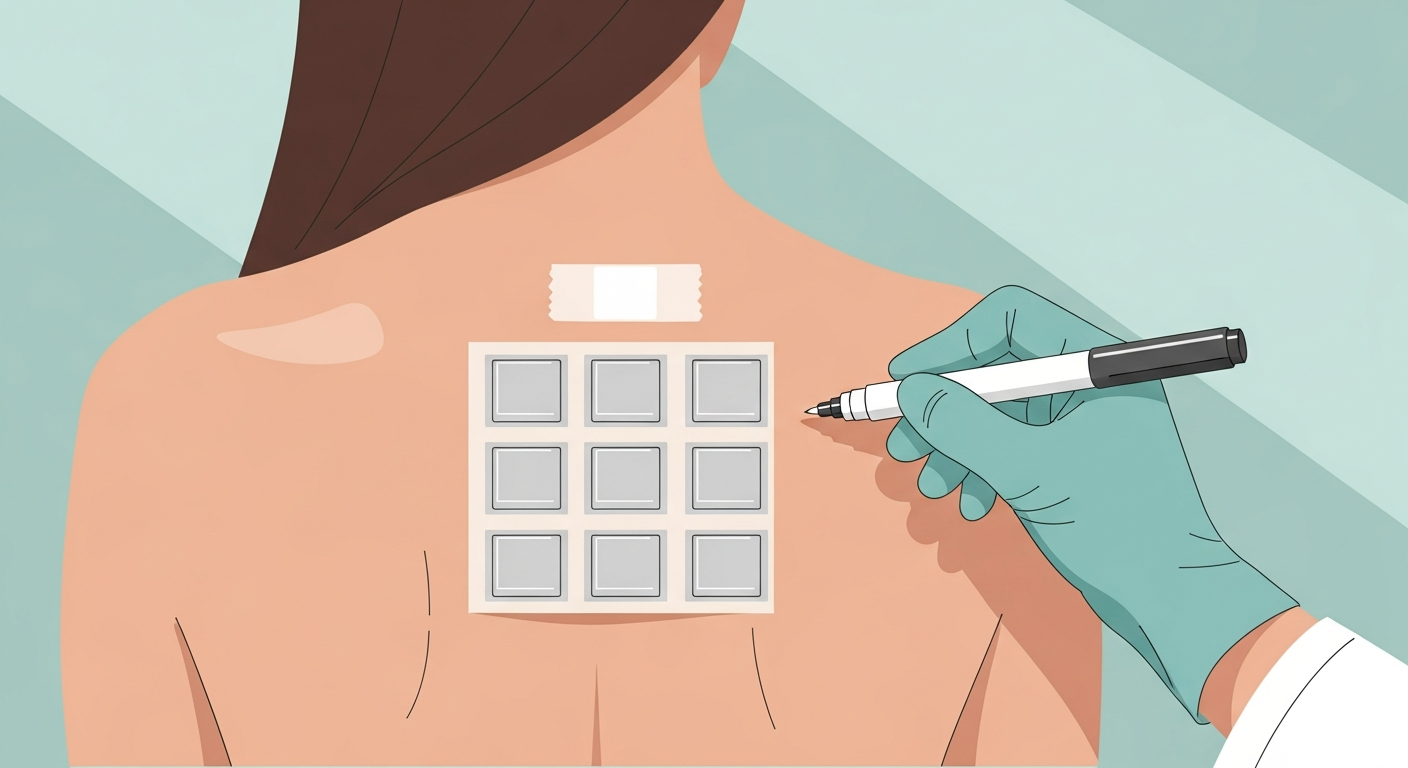
Allergens are applied on day 0 in Finn chambers fixed to the upper back with surgical tape and kept occluded for 48 hours. The chambers are removed on day 2, the back is marked with a dermographic pen, and an initial reading is taken after 30 minutes to allow pressure erythema from the chambers to fade. A second reading is performed on day 4, at 96 hours after application. The day 4 reading is the more diagnostically important because late reactions to metals (particularly nickel and cobalt) and some preservatives may not be visible at 48 hours. Some units add a day 7 reading when corticosteroid allergy is suspected, because a paradoxical late positive can occur with topical steroids. Candidates who know only the day 2 reading will be caught by questions designed around this late-reading rule.
Reading and grading patch test reactions
The International Contact Dermatitis Research Group (ICDRG) grading scale is the standard used in UK clinics. A doubtful reaction (?+) shows faint erythema only and is not a positive result. A weak positive (+) shows erythema and infiltration, possibly with papules. A strong positive (++) adds vesicles to the erythema, infiltration, and papules. An extreme reaction (+++) involves bullae or ulceration. Irritant reactions (IR) are homogeneous erythema without infiltration or follicular accentuation, often described as having a glazed or soap-like appearance. Crucially, irritant reactions tend to fade or resolve between day 2 and day 4, whereas allergic reactions persist or intensify. Once a positive is confirmed, clinical relevance must be recorded: current relevance means the allergen explains the current episode; past relevance means it explains a previous episode; unknown relevance means no clear exposure history can be established for that allergen.
The British Baseline Series
The British Baseline Series (BBS), maintained by the British Society for Cutaneous Allergy (BSCA), is the standard panel used in UK contact allergy clinics. It contains approximately 28 allergens chosen to detect the most prevalent contact sensitivities in the British population and detects around 80% of clinically relevant contact allergies without requiring extended or specialist panels. The list is reviewed periodically; a significant recent update added methylisothiazolinone (MI) as a standalone allergen in response to the surge in leave-on cosmetic preservative reactions. The following allergens are the most clinically important and most frequently tested.
- Nickel sulfate: the most common contact allergen overall; sources include jewellery, belt buckles, mobile phones, and jean studs
- Fragrance Mix I: screens for classic fragrances including cinnamic alcohol, eugenol, geraniol, isoeugenol, amyl cinnamaldehyde, hydroxycitronellal, and oak moss absolute
- Fragrance Mix II: screens for newer fragrances including hydroxyisohexyl 3-cyclohexene carboxaldehyde (HICC/Lyral), farnesol, citral, coumarin, and citronellol
- Methylchloroisothiazolinone/methylisothiazolinone (MCI/MI, Kathon CG): preservative in rinse-off cosmetics, shampoos, paints, and industrial biocides
- Methylisothiazolinone (MI) standalone: increasingly prevalent in leave-on wipes and cosmetics; associated with a high rate of sensitisation
- Para-phenylenediamine (PPD): the key allergen in permanent and semi-permanent hair dye; cross-reacts with benzocaine, sulphonamides, and para-aminobenzoic acid (PABA)
- Cobalt chloride: frequently co-sensitises alongside nickel; sources include hard metals, cobalt-containing pigments, and vitamin B12
- Potassium dichromate: the principal allergen in cement and leather goods (chrome-tanned leather); occupational exposure in construction workers and cobblers
- Thiuram mix: rubber accelerators present in gloves, condoms, and balloons; the most common cause of rubber glove allergy in healthcare workers
- Epoxy resin: used in adhesives, paints, floor coatings, and composite materials; occupational allergy in flooring and construction industries
- Colophony (rosin): found in adhesive tapes, sticking plasters, cosmetics, and varnishes; cross-reacts with balsam of Peru
- Neomycin sulfate: topical antibiotic allergen; cross-reacts with gentamicin and framycetin; relevant in leg ulcer and otitis externa patients
- Balsam of Peru (Myroxylon pereirae): a broad screen for fragrances and flavourings; also found in topical preparations and cosmetics
- Lanolin (wool alcohols): present in many emollients including aqueous cream; relevant when patients react to prescribed moisturisers
- Formaldehyde: preservative in cosmetics, shampoos, and fabric finishes; cross-reacts with formaldehyde-releasing preservatives
- Quaternium-15: a formaldehyde releaser found in cosmetics and household products; one of the commoner hidden sources of formaldehyde exposure
- Rubber mix (mercaptobenzothiazole, mercapto mix): alternative rubber-accelerator screen; complements thiuram testing
Finn chambers versus the TRUE Test
Most UK contact allergy clinics use Finn chambers: small aluminium cups, typically 8mm in diameter, loaded with the allergen preparation and fixed to the back with surgical tape. This system allows any allergen to be included at any concentration and is the method underlying the BSCA British Baseline Series. The TRUE Test (Thin-layer Rapid Use Epicutaneous Test) is a pre-loaded, ready-to-use panel covering 35 allergens on two self-adhesive strips of polyester film. It requires no preparation and suits primary care or smaller units without allergen-loading expertise. However, its allergen concentrations are fixed, and not every BSCA baseline allergen is represented. SCE stems may ask you to distinguish between the two: the TRUE Test cannot be customised for occupational or specialist allergens, whereas Finn chambers can accommodate any allergen in any vehicle at any concentration.
ROAT and photopatch testing
The repeated open application test (ROAT) is used when the patch test result is equivocal or doubtful but clinical suspicion of allergy to a cosmetic or leave-on product remains high. The patient applies the suspect product twice daily to the antecubital fossa or the skin behind the ear for up to four weeks. Development of erythema or papules constitutes a positive ROAT and indicates clinically relevant allergy even when the formal patch test reading was only doubtful. Photopatch testing introduces ultraviolet irradiation as an additional variable: two sets of chambers are applied on day 0; one set is irradiated with UVA (typically 5 J/cm2) after 24 to 48 hours, and both sets are read at 48 and 72 hours. Photoallergic reactions occur only in the irradiated site, distinguishing photocontact allergy from ordinary contact allergy. Common photoallergens include UV filters (oxybenzone, benzophenone-4), NSAID gels (ketoprofen), and certain aftershave fragrances. A further concept that appears in the SCE is systemic contact dermatitis: a generalised cutaneous flare triggered by oral, intravenous, or inhaled exposure to an allergen to which the patient is already sensitised via the skin. Nickel ingestion and amoxicillin exposure in patients sensitised to ampicillin by prior topical use are the classic examples.
What to focus on in the question bank
The DermSCE question bank includes a dedicated allergy and contact dermatitis section with questions covering allergen identification from occupational history, the immunological mechanism, reading schedules, ICDRG grading, and the distinction between allergic and irritant contact dermatitis. Related topics include urticaria, drug reactions, and angioedema. A reliable approach to any contact allergy stem is to ask three questions in sequence: what type of hypersensitivity is this (and therefore what is the expected time course); which allergen is most plausibly linked to the exposure history and the distribution of the rash; and what is the next most appropriate investigation or management step. Candidates who anchor to mechanism rather than memorising allergen lists in isolation perform consistently better on this topic.
Sources & further reading
- British Society for Cutaneous Allergy (BSCA) -- British Baseline Series
- Bourke J et al. Guidelines for care of contact dermatitis. Br J Dermatol 2009;160:946-954
- British Association of Dermatologists -- patient information on patch testing
- Johansen JD et al. European Society of Contact Dermatitis guidelines for diagnostic patch testing. Contact Dermatitis 2015;73:195-221
- JRCPTB Dermatology SCE syllabus
For educational use only. Check current official guidance.
Start 25 free questions