One month to go: how to use the final four weeks before the Dermatology SCE
A doctor who has sat the Dermatology SCE on using the final month well: repeat two question banks, close gaps, time full mocks and taper in the last 48 hours.
By Dr Ahmed Zwain
A month out, most candidates can produce a long list of topics they haven't covered properly. The list is usually accurate. It is rarely useful.
I've sat the Dermatology SCE, and I've since spent a lot of time helping other doctors prepare through DermSCE, the platform I created. The change I'd push hardest at this stage is to stop trying to finish dermatology. You aren't going to finish it, and the attempt eats the four weeks you actually have. What you can do now is make the knowledge you already hold faster to retrieve, and repair the gaps most likely to show up as a plausible wrong option on the day.
Here's how I would use the time.
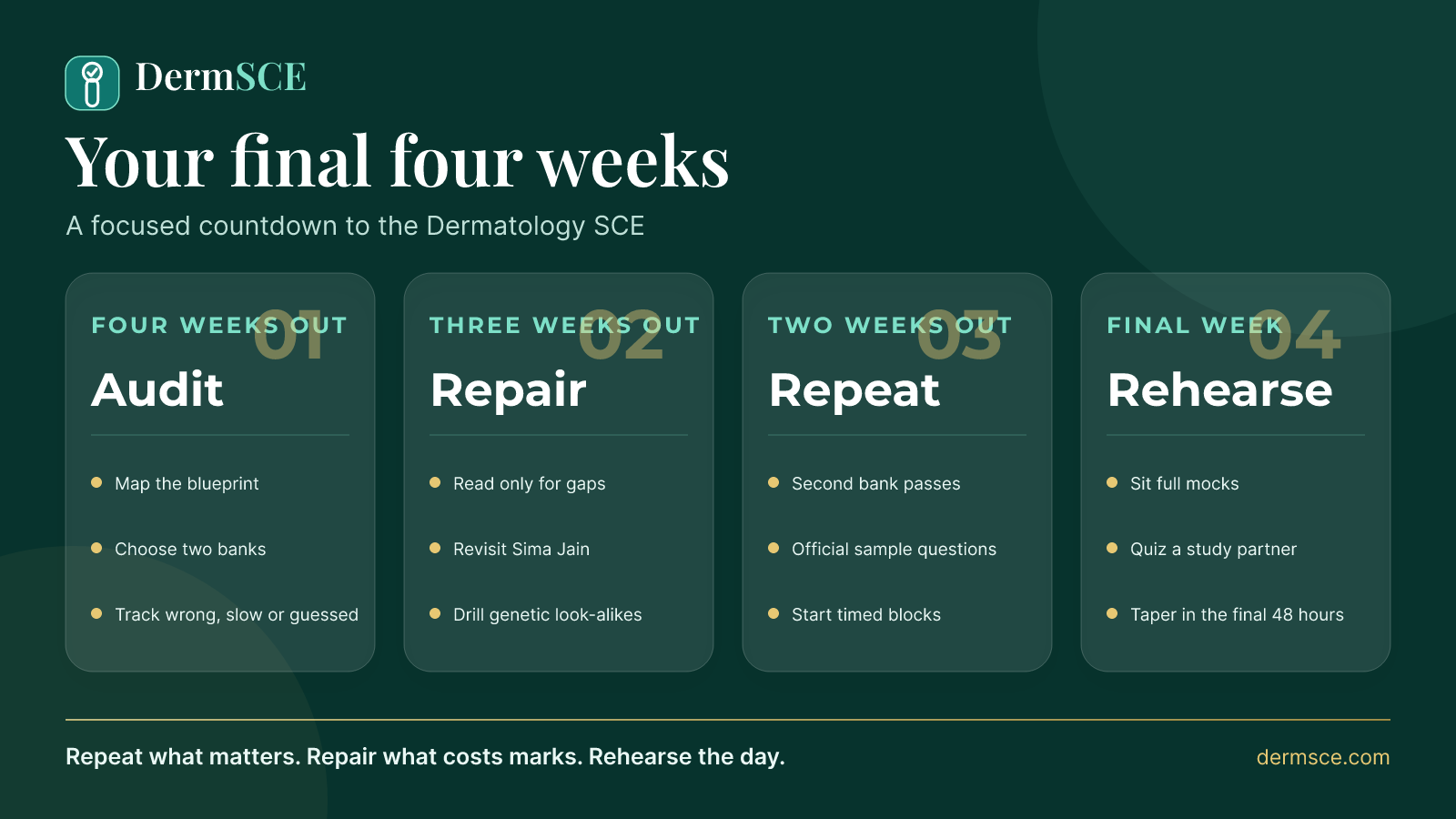
Four weeks out: audit before you add anything
The Federation delivers the Dermatology SCE once a year, and questions cover the curriculum according to a predetermined blueprint. Start there. Put the blueprint next to an honest record of what you've actually revised, rather than what you intended to revise in September.
I don't mean an elaborate colour-coded spreadsheet. Three categories will do:
- Green: covered, and retrievable under question conditions.
- Amber: familiar, but slow or inconsistent.
- Red: repeatedly wrong, guessed, or barely touched.
Be suspicious of green. Recognising a page of your own notes is a much lower bar than picking the single best answer from five options. The official questions are best-of-five, with one correct answer and four plausible but less correct alternatives, and they test interpretation and clinical problem-solving as well as recall. A topic is only secure when you can say why the near-miss option is worse.
This is also the week to choose the two question banks you'll repeat for the rest of the month. Two. Then repeat them.
Adding a third bank is the standard response to anxiety, and it feels productive because every new set of questions throws up new facts. The trouble is that it keeps you permanently in first-pass territory, meeting unfamiliar material and never returning to the mistakes that matter. A public dermatology-specific candidate discussion suggests pairing a question bank with the official Federation material, which is a sensible combination rather than proof of anything. Public DermSCE reviews also value clinically relevant questions, explanations that cover the distractors, concise exam-focused notes and broad topic coverage. Those are useful preferences, not evidence about who passes.
So pick two banks you already know and can realistically get through again, then set up a simple error and gap system. Every question that's wrong, guessed or unusually slow should trigger one of three things:
- A short recall prompt added to your existing notes.
- A targeted read of one section of a book or guideline.
- An entry on a retest list to revisit within a few days.
Slow counts. If you land on the right answer only after cycling through all five options twice, that knowledge isn't reliable enough yet.
A worked revision tracker
I keep the record small enough to use every day. The point is not to produce a beautiful spreadsheet. It is to turn an error into one clear correction and a definite retest.
| Trigger | What I noticed | Small correction | When I will retest |
|---|---|---|---|
| A question I got wrong | I changed my first answer twice | Write one discriminator in my own words | Within 48 hours |
| A question I guessed | I recognised the topic but could not retrieve the distinction | Add one blank comparison prompt | In the next repeat pass |
| A question I answered slowly | I reread the stem instead of committing | Practise one timed five-question block | At the next timed session |
Use the final column as a promise rather than a diary entry. If the same trigger appears again, make the correction smaller, not the notes longer.
Reuse the notes you already made
This is not the month for beautiful new notes.
Your own notes already contain the phrasing, associations and shortcuts that made the material stick the first time. Rewriting them into something neater feels like work and mostly replaces retrieval with transcription. Repeat them instead, and repeat them often.
Better still, turn them into questions. Cover one column of a table and reproduce it. Hide the diagnosis and rebuild it from the clinical features. Say a drug's target, monitoring requirements and main cautions out loud before you check. Look at an immunofluorescence pattern and commit to a differential first.
Practice testing, retrieval and spaced repetition are well supported as learning methods. In practical terms that means returning to the same material after a gap and forcing yourself to produce the answer, rather than reading it again and feeling reassured.
Three weeks out: close the gaps that are costing marks
By now the audit and your first repeat pass should be showing patterns, and they're usually specific. Porphyrias blurring together. Direct immunofluorescence findings that won't stay put. Hesitation over biologic targets. Time lost separating two genodermatoses that share a facial feature.
Read for those gaps and nothing else. Question first, read just enough to close it, then retest.
For management questions, go back to the relevant UK guideline rather than trusting a single explanation. For pathology, immunology and rare disease, use whichever reference text you've already been using. Resist reading a whole chapter because one paragraph exposed you.
My own high-yield recommendation, and I'm offering it as personal exam preparation advice rather than any official statement about the syllabus, is to revisit the first two chapters and the final pages of the Sima Jain edition you've been using. They reward a return visit when time is short, particularly if you've already worked through the book and can map them onto your existing notes.
Owning the resources isn't the point. Making them talk to each other is: questions find the gap, reading repairs it, retrieval tells you whether the repair held.
Give genetics deliberate attention
Genetic conditions need their own plan, because they're easy to recognise vaguely and hard to separate precisely.
A stem will hand you overlapping features and then ask for the inheritance pattern, the affected protein, the malignancy association or the surveillance implication. Having read about a syndrome won't get you between two plausible options.
Build comparison tables or recall grids with columns for:
- inheritance pattern
- gene and chromosome, where relevant
- protein or pathway
- hallmark cutaneous findings
- important extracutaneous features
- malignancy associations
- surveillance or management clues
The table is the starting point, not the work. Cover columns and reproduce them from memory. Put look-alike syndromes side by side and ask what single detail separates them. Where two conditions keep collapsing into one another, write yourself a question designed specifically to force the distinction.
A sample template keeps the comparison honest. I leave the cells blank until I have checked the source I trust, rather than filling them from memory and accidentally turning a guess into a note.
A sample syndrome comparison template
| Prompt | Syndrome / condition A | Syndrome / condition B | Check before learning |
|---|---|---|---|
| Name used in my source | [blank] | [blank] | Copy the term exactly |
| Single discriminator | [blank] | [blank] | Write one feature only |
| Clinical pattern | [blank] | [blank] | Use a concise phrase |
| Associated clues | [blank] | [blank] | Separate known from uncertain |
| Question wording | [blank] | [blank] | What word would change my choice? |
| Source checked | [blank] | [blank] | Add the title and date |
This is a framework, not a completed clinical table. Fill it from your approved reference, cover one column, and then ask yourself which single detail would move you to the other option.
The same approach earns its keep in immunobullous disease, connective tissue disorders, vasculitides, porphyrias, photodermatoses and drug mechanisms. Anywhere the wrong options are likely to be plausible, comparative recall beats another descriptive paragraph.
Two weeks out: second passes and the official questions
Repeat both banks. Prioritise the wrong, guessed and slow questions, but don't confine yourself to them, because previously correct answers are a decent check against false familiarity.
Scores at this stage need careful handling. A higher percentage may just mean you remember the question, which is still useful retrieval but tells you nothing about your result. A lower percentage on a demanding block may be the most informative session of your week. Read what the answers reveal rather than the number at the top.
Convert explanations into recall prompts as you go:
- What makes option B less correct than option D?
- Which investigation actually changes management?
- What is this drug's target?
- Which of these syndromes carries the malignancy risk?
- What single feature would make this diagnosis unlikely?
Because the official alternatives are plausible by design, understanding why four options fail is often worth more than memorising the fifth.
Sit the official Federation Dermatology sample questions this week. They're the examiners' own examples of the format, so treat them as essential familiarisation rather than a nice extra. Do them properly, then go back over the wording of the lead-ins and the fine distinctions between the options.
Move from knowing answers to performing under the clock
Introduce timed blocks now. The question is no longer whether you can answer, but whether you can decide and move.
Practise a two-pass method. First pass: answer what's accessible, flag anything that needs more thought, keep going. Come back to the flagged items later instead of spending five minutes forcing one answer. There are more accessible marks further down the paper than there are in winning an argument with a single stubborn stem.
Some of this practice has to be full mocks rather than sets of ten. Full-length papers expose things short blocks hide: concentration drifting, compulsive rechecking, flagging half the paper, and the slump that follows a run of hard questions.
Timed mock review sheet
I do not only record the score. Immediately after a mock, I record what happened to my process while it is still clear, then choose one adjustment for the next sitting.
| Check | Record | Next adjustment |
|---|---|---|
| First pass finish | [time / question number] | Was my pace steady? |
| Flagged items | [number / main reason] | Choose a rule for returning |
| Unanswered items | [number / why] | Practise making a clear first decision |
| Attention dip | [where it happened] | Plan one short reset cue |
| Review completed | [date / gap list] | Choose up to three retest prompts |
The sheet should take a few minutes, not become another revision project. It tells me whether the next session needs content repair, better reading of the lead-in or more disciplined pacing.
I designed DermSCE's mock mode to help candidates rehearse that process. It offers timed 100- and 200-question modes, flagging, and a deliberate mix of straightforward and demanding questions, with explanations afterwards so a bad block turns into a gap list rather than a bad mood. I'd be clear about the limits, though: no question bank, DermSCE included, can reproduce the examination's standard setting or predict what you'll score. Use mock results to steer revision and technique, not as a forecast.
The real paper can feel uneven. One question may be genuinely difficult and unfamiliar; the next may ask a short factual point about a drug target, for example that lebrikizumab targets IL-13. Part of the skill is switching between those levels cleanly, without letting the previous question follow you into the next one.
The month at a glance
When the plan starts to feel noisy, I reduce it to the next output. Each week has a job, and each job should leave something I can use again.
| Stage | Main job | Leave with |
|---|---|---|
| Four weeks out | Audit and choose the repeat resources | A green, amber and red map |
| Three weeks out | Repair the gaps that cost time or marks | Small corrections and comparison prompts |
| Two weeks out | Repeat and introduce timed blocks | A retest list and pacing notes |
| Final week | Rehearse complete papers and spoken recall | A short, trusted final set of notes |
| Final 48 hours | Organise and reduce the volume | Familiar prompts, practical arrangements and a calmer start |
The final week: rehearse, share, reduce the noise
Full mocks, final notes, spoken recall. That's the week.
Time several complete mocks under conditions that make you keep moving, and practise flagging with some discipline. Review them afterwards, but don't answer every missed niche fact by opening a new major resource. Ask instead whether the error was a real gap, a misread lead-in, weak recall or poor pacing. Those need different fixes.
Share your final notes and your uncertain points with a study partner, then quiz each other aloud. Speaking is unforgiving in a useful way; you find out very quickly whether you know a condition or only recognise it on the page.
Keep those sessions tight. Each of you brings:
- five easily confused diagnoses
- five mechanisms or drug targets
- five genetic conditions
- five management uncertainties
- a short list of facts you keep getting wrong
Explain the reasoning, not just the answer. If you disagree, check the source rather than leaving it hanging.
Short bursts of repetition on your phone work well this week too. A concise set of prompts you already know is worth more than a large book you won't open on the train.
The final 48 hours: organise, don't expand
The last couple of days are for organising your thoughts and reinforcing familiar material. They are not for starting a new question bank or opening a new book.
New resources have a habit of making a prepared candidate feel underprepared. A different author's emphasis, unfamiliar terminology and a fresh crop of obscure facts arrive precisely when you need coherence, and the discomfort that follows usually reflects novelty rather than a genuine deficit.
Go back over:
- your error and gap list
- the genetics comparison grids
- drug targets and key monitoring points
- immunology, pathology and investigation patterns
- the diagnoses you repeatedly confuse
- the notes you've already repeated several times
Then reduce the volume. Nobody has ever pushed the whole curriculum through working memory on the final evening.
In the examination room
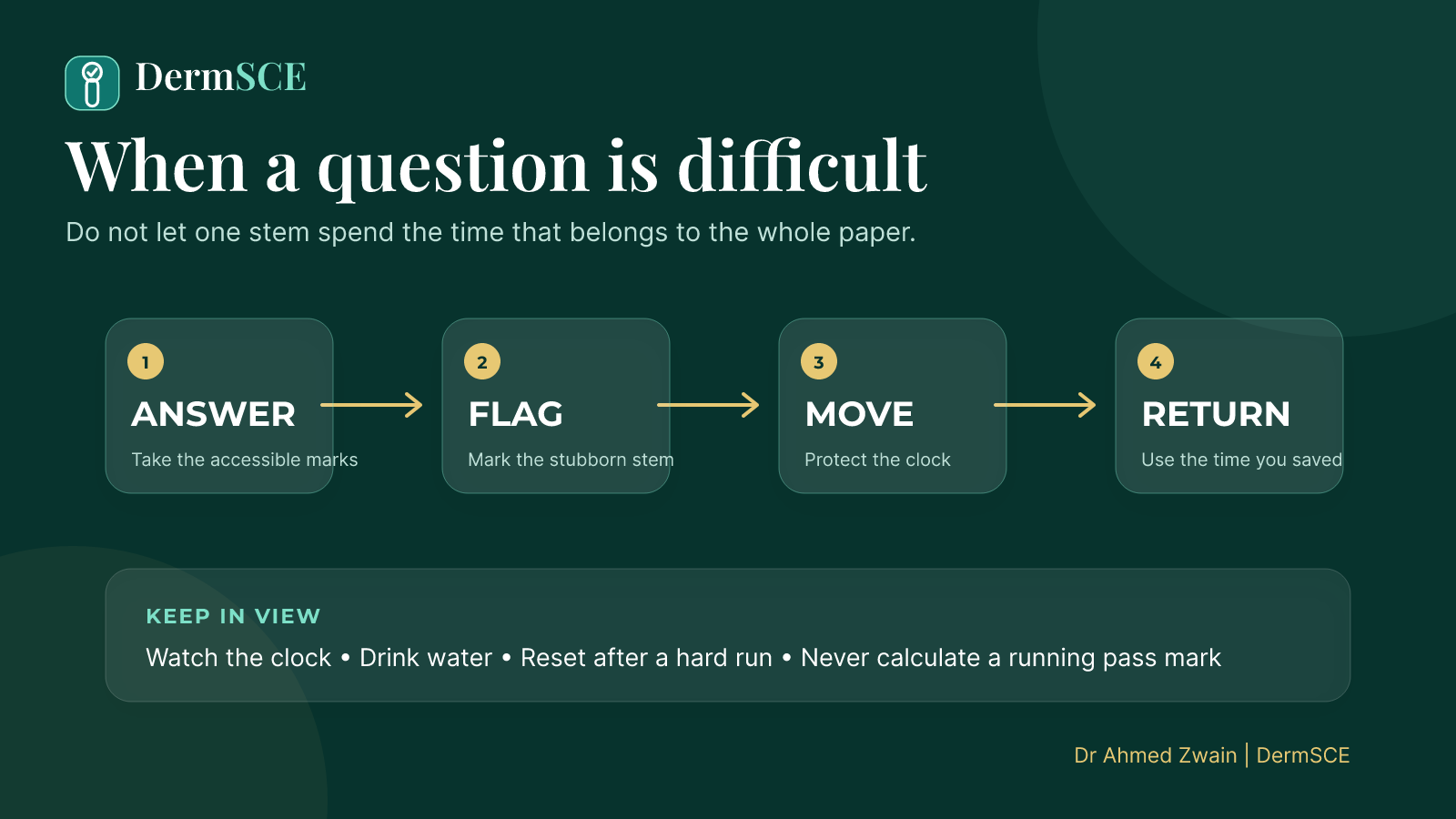
Timekeeping is part of the exam rather than an administrative detail. Track your progress and protect enough time to return to the questions you've flagged.
When a question is hard, make your best decision, flag it, move on. The next item may test something you know outright.
Drink enough water and use any permitted break to reset. After a difficult run, take a breath and start the next lead-in properly rather than carrying the last one with you. The paper may well feel uneven, and that feeling tells you very little.
One more thing, and I mean this: don't try to calculate a running pass mark while you're sitting the paper. The result is determined through the examination's official process, and you cannot reconstruct it from inside the room. Counting the answers that felt certain will cost you attention and give you nothing reliable in return.
Deal with the question in front of you.
Final-month checklist
- Map strengths and gaps against the blueprint.
- Choose two question banks and repeat them.
- Track every wrong, guessed and slow answer.
- Reuse existing notes rather than rewriting them.
- Revisit the first two chapters and final pages of Sima Jain.
- Drill genetics and look-alike conditions with comparison grids.
- Complete the official Federation sample questions.
- Sit multiple timed full mocks and practise flagging.
- Quiz a study partner aloud.
- Taper in the final 48 hours.
- On the day: watch the clock, drink water, flag and reset.
- Leave the score calculations to the formal result.
Once you finish, breathe. You have made it. Then you wait.
Sources & further reading
- Official Federation Dermatology SCE page
- Official Federation Dermatology sample questions
- Candidate discussion
- Retrieval practice and spaced learning
- DermSCE product page
- Public DermSCE reviews
For educational use only. Check current official guidance.
Start 25 free questions