Genodermatoses in the Dermatology SCE: gene-condition pairings, inheritance patterns and classic presentations
A high-yield revision guide to genodermatoses for the Dermatology SCE: tuberous sclerosis, neurofibromatosis, Gorlin syndrome, epidermolysis bullosa subtypes, and the gene-condition pairings the paper tests most often.
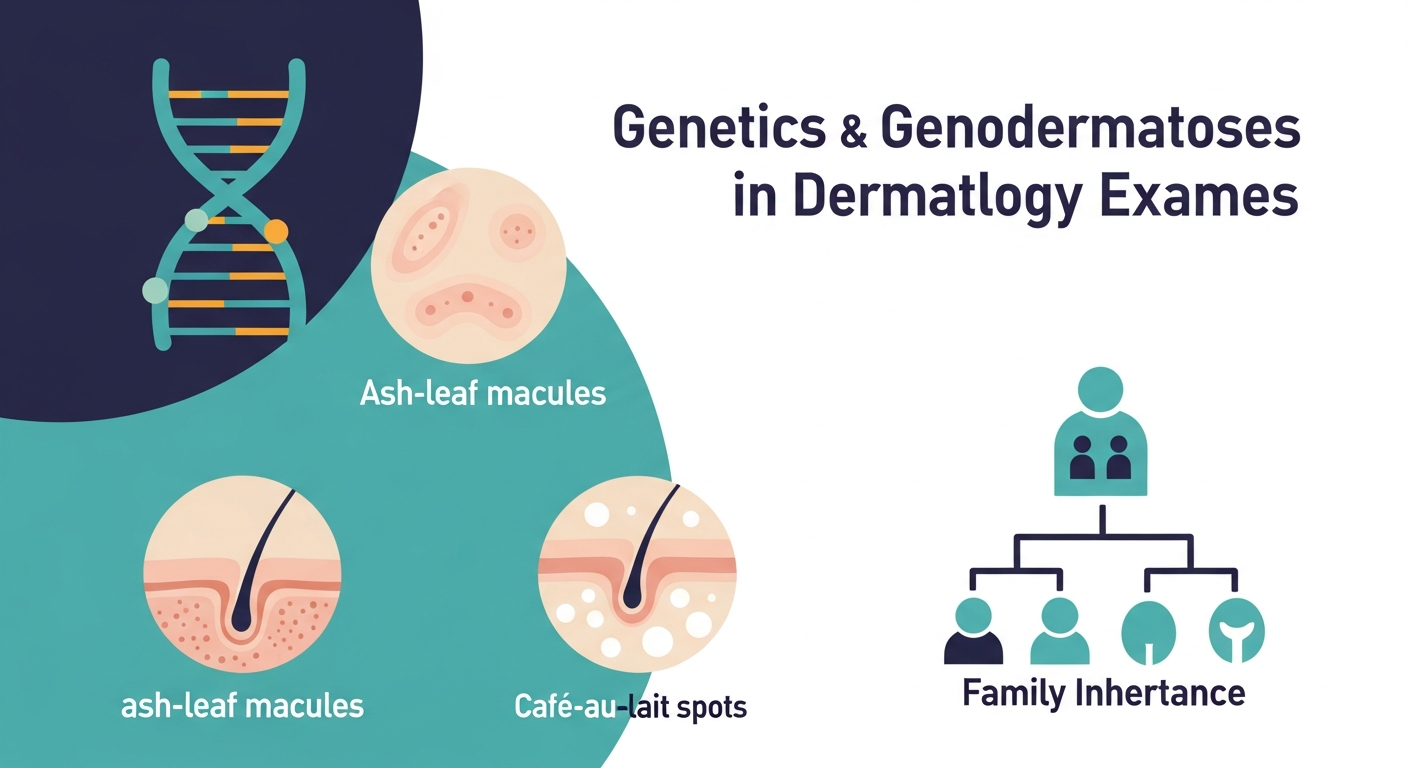
Genetics and paediatric dermatology together account for roughly 30 of the 200 questions in the Dermatology SCE, making this the second largest blueprint domain after general dermatology. More importantly, it is one of the most learnable: the questions are overwhelmingly built around a fixed inventory of gene-condition pairings, inheritance patterns, and classic clinical features. Once that inventory is memorised, most of the marks in this domain are within reach.
Why genetics deserves dedicated revision time
- questions from paediatrics and genetics per sitting
- ~30
- largest blueprint domain after general dermatology
- 2nd
- return on investment: fixed inventory of examinable facts
- high
Many candidates under-revise this area because it feels remote from day-to-day dermatology clinic work. That is a mistake. Genodermatoses questions are almost always built around the same handful of conditions: tuberous sclerosis, neurofibromatosis, Gorlin syndrome, epidermolysis bullosa and a small number of others. A focused revision session on each will cover the overwhelming majority of what appears.
Gene-condition pairings to know cold
The SCE consistently tests whether you can link a gene to a condition, or a chromosome to a gene. These are the pairings that appear most often.
- Tuberous sclerosis complex (TSC): TSC1 (hamartin, chromosome 9) or TSC2 (tuberin, chromosome 16). Autosomal dominant. Key features: ash-leaf macules (best seen under Wood's light), facial angiofibromas, periungual fibromas (Koenen tumours), shagreen patches, cardiac rhabdomyomas, renal angiomyolipomas and subependymal giant cell astrocytomas (SEGAs) on brain imaging.
- Neurofibromatosis type 1 (NF1): NF1 gene (neurofibromin, chromosome 17). Autosomal dominant, but around half of all cases are de novo mutations with no family history. Diagnosis requires at least two of the seven NIH criteria: six or more cafe-au-lait macules, axillary or groin freckling (Crowe's sign), two or more neurofibromas, plexiform neurofibroma, optic glioma, two or more Lisch nodules, a distinctive osseous lesion, or a first-degree relative with NF1.
- Neurofibromatosis type 2 (NF2): NF2 gene (merlin/schwannomin, chromosome 22). The hallmark is bilateral vestibular schwannomas. Fewer cutaneous features than NF1.
- Gorlin syndrome (basal cell naevus syndrome): PTCH1 gene (patched-1, chromosome 9). Autosomal dominant. Multiple BCCs from adolescence, odontogenic keratocysts of the jaw, calcification of the falx cerebri, skeletal anomalies including bifid ribs, and an increased risk of medulloblastoma (desmoplastic/nodular subtype).
- Darier disease (keratosis follicularis): ATP2A2 gene (SERCA2 calcium pump, chromosome 12). Autosomal dominant. Greasy keratotic papules in a seborrhoeic distribution, V-shaped nail notching, palmoplantar pits, and white longitudinal nail streaks. The disease worsens with heat and sweating.
- Hailey-Hailey disease (familial benign pemphigus): ATP2C1 gene (SPCA1 calcium pump, chromosome 3). Autosomal dominant. Superficial erosions and maceration in flexural sites; histology shows acantholysis at multiple suprabasal levels, unlike Darier disease which shows predominantly suprabasal acantholysis in a different distribution.
- Xeroderma pigmentosum: multiple XP genes (XPC, XPD and others). Autosomal recessive. Defective nucleotide excision repair leads to extreme ultraviolet sensitivity, early-onset skin cancers, and in some subtypes progressive neurological degeneration.
Epidermolysis bullosa: cleavage planes and genes
EB is a frequent source of SCE questions because it combines genetics with histopathology and salt-split skin immunofluorescence. The three main groups are defined by the level of blistering within the skin.
On split-skin immunofluorescence, antibodies to type VII collagen (relevant to EB dystrophic and epidermolysis bullosa acquisita) bind the floor of the artificial blister. Antibodies to laminin 332 also bind the floor in junctional EB. This distinction matters because the same technique is used in immunobullous disease, where BP180 antibodies bind the roof.
Inheritance patterns and the classic exceptions
- Autosomal dominant conditions most commonly tested: tuberous sclerosis complex, NF1, NF2, Gorlin syndrome, Darier disease, Hailey-Hailey disease, EB simplex (most forms), EB dystrophic dominant subtype, pachyonychia congenita, many palmoplantar keratodermas.
- Autosomal recessive conditions most commonly tested: xeroderma pigmentosum, EB junctional (Herlitz and non-Herlitz), EB dystrophic recessive, lamellar ichthyosis, Chediak-Higashi syndrome, oculocutaneous albinism.
- X-linked conditions: X-linked ichthyosis (steroid sulphatase deficiency, X-linked recessive), Fabry disease (alpha-galactosidase A deficiency, X-linked recessive with cardiac and renal involvement), incontinentia pigmenti (X-linked dominant, lethal in hemizygous males so seen almost exclusively in females).
- Variable expressivity in dominant conditions: penetrance is near-complete in tuberous sclerosis and Gorlin, but expressivity varies widely within families. A mildly affected parent does not change the 50% offspring risk; this is a frequent SCE trap.
- De novo mutations: NF1 has one of the highest spontaneous mutation rates of any autosomal dominant condition. Around half of all NF1 cases arise de novo with no family history. The SCE may present a case with no affected relatives and ask whether the diagnosis is still possible; the answer is yes.
The SCE hotspots within each condition
Beyond gene pairings, a handful of specific clinical facts carry the bulk of marks within this domain.
- Tuberous sclerosis and epilepsy: over 80% of patients with TSC develop epilepsy; infantile spasms are the classic early presentation. mTOR inhibitor therapy (everolimus, sirolimus) is used for SEGAs, renal angiomyolipomas and selected skin lesions.
- Gorlin syndrome and medulloblastoma subtype: Gorlin-associated medulloblastoma is the desmoplastic/nodular subtype, not the classic midline cerebellar tumour. This distinction can appear in questions that combine oncology with genetics.
- NF1 and malignant transformation: plexiform neurofibromas may undergo malignant transformation to malignant peripheral nerve sheath tumours (MPNSTs), the leading cause of NF1-related death in adults. Rapid growth or new pain in a plexiform neurofibroma should prompt imaging; this is a classic SCE scenario.
- Darier disease and viral infection: the disrupted skin barrier in Darier disease predisposes to widespread herpes simplex infection, producing the equivalent of eczema herpeticum. Prompt antiviral treatment is essential; this is a well-recognised SCE clinical scenario.
- Prenatal testing: for severe autosomal recessive conditions (for example Herlitz EB), chorionic villus sampling or amniocentesis for molecular diagnosis is available when the causative mutation has been identified in the family. This may appear in clinical genetics counselling questions.
How DermSCE helps with genetics
Genetics questions reward recognition speed: the scenario describes a feature set and you need to retrieve the gene, chromosome, or inheritance pattern instantly. Repeated question practice builds that retrieval faster than reading alone.
- Topic filter for genetics and paediatrics: drill genodermatoses questions separately until pattern recognition is reliable, then mix them into full mock sessions.
- Explanations that teach, not just correct: every answer explains why each distractor is wrong, for example why TSC2 is not on chromosome 17 (that is NF1), so similar-sounding genes do not become a persistent trap.
- Exam-standard difficulty: questions are written to SCE single-best-of-five format, with clinical scenarios rather than bare recall, so the gene-condition pairing must be retrieved in context.
- Progress tracking: your accuracy by topic shows whether genetics is a genuine weak area or already solid, helping you decide where to invest remaining revision time.
For context on where genetics sits in the wider revision picture, see our highest-yield topics guide. Our paediatric dermatology post covers the clinical presentations that overlap most closely with genodermatoses.
Sources & further reading
- Tuberous sclerosis complex: diagnosis and management (NG128) - National Institute for Health and Care Excellence
- Neurofibromatosis type 1 (NG114) - National Institute for Health and Care Excellence
- Gorlin syndrome: guidelines for diagnosis and management - British Association of Dermatologists
- Epidermolysis bullosa - patient information and clinical guidelines - EB Research Partnership
- Darier disease - DermNet
For educational use only. Check current official guidance.
Start 25 free questions