Skin surgery in the Dermatology SCE: excision margins, local anaesthesia and flap principles
A focused revision guide to the skin surgery questions in the Dermatology SCE: BCC and melanoma excision margins, maximum local anaesthetic doses, surgical flap principles, and the clinical scenarios that recur most often.
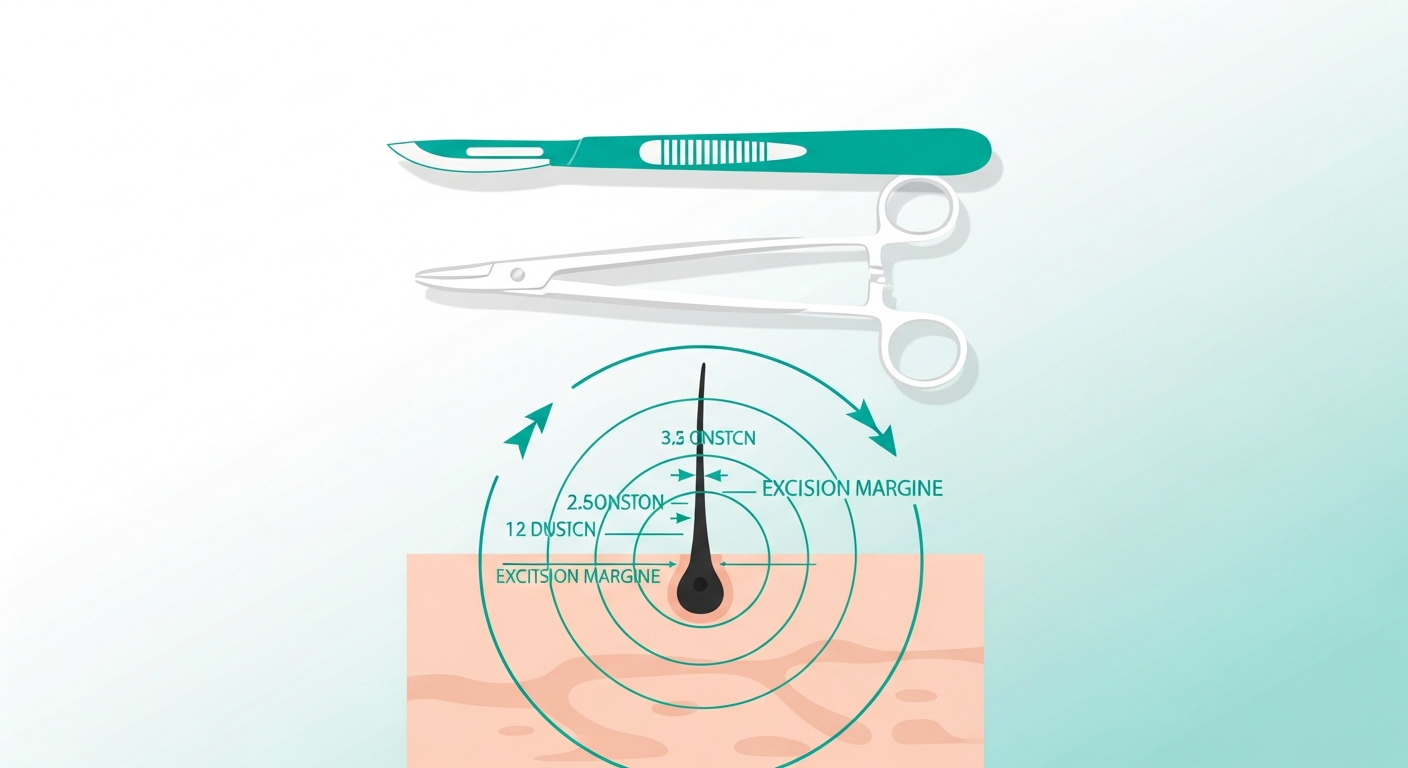
Skin surgery sits at roughly ten questions in each sitting of the Dermatology SCE, which makes it one of the smaller domains by volume but one of the more predictable by content. The questions cluster tightly around three areas: excision margins for non-melanoma skin cancer and melanoma, local anaesthetic pharmacology, and the basic principles of surgical flap repair. Master those three clusters and most of the marks in this domain are yours.
What the blueprint says about skin surgery
- questions from skin surgery per sitting
- ~10
- core areas tested (margins, local anaesthesia, flaps)
- 3
- primary UK guideline sources (BAD + NICE)
- 2
The skin surgery section of the blueprint is not large, but the questions that appear are consistently derived from published UK guidelines, primarily the British Association of Dermatologists (BAD) surgical guidelines and the NICE and BAD guidance on melanoma. Working through those documents once will anchor the margin and dosing facts that examiners return to year after year.
Excision margins for basal cell carcinoma
The BAD guidelines on surgical excision of BCC are the primary source for SCE questions in this area. The key facts are the peripheral clinical margin needed for different levels of histological clearance, and which BCC subtypes are appropriate for standard surgical excision.
- 3 mm peripheral clinical margin is the minimum recommended for a well-defined, low-risk primary BCC. At this margin approximately 85% of tumours are histologically completely excised.
- 4-5 mm peripheral margin is needed to achieve approximately 95% histological clearance for a well-defined primary BCC on a low-risk site. The SCE often presents this as the margin required to hit the 95% threshold.
- High-risk and ill-defined BCCs (including morphoeic and infiltrative subtypes) require wider margins or margin-controlled surgery (Mohs micrographic surgery or slow Mohs). Standard excision is not recommended as first-line for these subtypes.
- Recurrent BCCs have lower cure rates after standard surgical excision and warrant margin-controlled surgery. Five-year cure rates after adequate excision of primary well-defined BCCs exceed 95%.
- Mohs micrographic surgery gives the highest cure rates for high-risk, recurrent, or functionally critical site BCCs. It is the preferred treatment for BCCs on the nose, eyelids, lips and ears where tissue conservation matters.
Melanoma excision margins
Melanoma margins are set by Breslow thickness and follow the NICE melanoma guideline (NG14, updated 2022) and the BAD revised guidelines. These are the figures the SCE tests.
- In situ melanoma (Breslow 0): 5 mm margin. The SCE uses the standard 5 mm figure; the minimum of 2 mm is a surgical fallback, not the target.
- Breslow 1 mm or less (pT1): 1 cm peripheral margin.
- Breslow 1.01-2 mm (pT2): 1-2 cm. UK guidelines favour 1 cm in most anatomical sites, with 2 cm discussed at multidisciplinary team level.
- Breslow 2.01-4 mm (pT3): 2 cm margin.
- Breslow greater than 4 mm (pT4): 2 cm margin. A 3 cm margin is no longer recommended in UK guidelines.
- Sentinel lymph node biopsy (SLNB): offered from Breslow 1 mm upwards (and from 0.75 mm if adverse features are present such as ulceration or high mitotic rate), primarily for staging and prognostic information rather than proven survival benefit in the UK.
Local anaesthesia: maximum doses and volume calculations
Local anaesthetic pharmacology is a consistent source of SCE questions. The three agents most commonly tested are lignocaine (with and without adrenaline), bupivacaine, and prilocaine. The SCE regularly asks you to calculate a maximum volume from a patient weight and solution concentration.
- Lignocaine without adrenaline: maximum 3 mg/kg, absolute cap 200 mg. In a 70 kg patient that is 210 mg; the absolute cap applies, so the answer is 200 mg (20 ml of 1% solution).
- Lignocaine with adrenaline (1 in 200,000): maximum 7 mg/kg, absolute cap 500 mg. In a 70 kg patient that is 490 mg (49 ml of 1% solution). Adrenaline reduces systemic absorption and prolongs the block, more than doubling the safe dose.
- Bupivacaine: maximum 2 mg/kg without adrenaline; 2.5 mg/kg with adrenaline. Bupivacaine is more cardiotoxic than lignocaine; the SCE tests awareness of arrhythmia risk on inadvertent intravascular injection.
- Prilocaine: maximum 6 mg/kg. Used in EMLA cream and Bier's block. High doses cause methaemoglobinaemia by oxidising haemoglobin via the metabolite orthotoluidine, a classic pharmacology trap in the SCE.
- Adrenaline and special sites: the older caution about avoiding adrenaline in digital blocks has been revised. Adrenaline at standard concentrations (1 in 200,000) is now considered acceptable in digital blocks in patients without vascular compromise, though the SCE may still present classic contraindications in cardiac arrhythmia or phaeochromocytoma.
Surgical flap principles
Flap questions test classification and the principle of tissue movement rather than operative technique. A reliable classification is by method of movement, which maps directly to the names the SCE uses.
- Advancement flap: tissue is moved directly forward into the defect without rotation or lateral movement. The V-Y advancement and H-plasty are the most commonly tested examples.
- Rotation flap: a semicircular arc of tissue is pivoted around a fixed point to close an adjacent defect. The rotation point limits reach, and the flap must be considerably larger than the defect it closes.
- Transposition flap: tissue is lifted and moved laterally across intervening normal skin. The rhomboid (Limberg) flap and the bilobed flap (used on the nose) are the most commonly tested examples.
- Interpolation flap: passes over or under normal skin to reach a non-adjacent defect, requiring a pedicle division as a second stage. The paramedian forehead flap for nasal reconstruction is the classic example.
- Choice of flap depends on defect site, size, tissue laxity and blood supply. The SCE may ask which flap type is most appropriate for a given defect; the answer almost always depends on tissue movement direction and whether normal skin must be crossed.
Other skin surgery topics worth knowing
- Wound healing phases: haemostasis (0-24 hours), inflammation (1-4 days), proliferation (4 days to 3 weeks), and remodelling (3 weeks to 2 years). Maximum tensile strength (around 80% of unwounded skin) is reached during remodelling, never at wound closure.
- Suture materials: absorbable (Vicryl, Monocryl, PDS) versus non-absorbable (nylon, polypropylene). The SCE tests which is appropriate for deep dermal versus surface closures, and which materials carry the highest tissue reactivity.
- Keloid versus hypertrophic scar: hypertrophic scars remain within the wound boundary and often regress; keloids extend beyond the original wound edges and rarely regress spontaneously. Treatment differs: keloids require intralesional corticosteroid, silicone, and pressure; surgery alone carries high recurrence and should be combined with adjuvant therapy.
- Curettage and cautery: appropriate for superficial BCCs and Bowen disease on the trunk and limbs; not appropriate for high-risk sites (central face, ears) or aggressive subtypes where margins cannot be assessed.
How DermSCE helps with skin surgery
- Topic filter: select skin surgery directly and work through margin, local anaesthetic dosing and flap questions without distraction.
- Worked explanations: every answer explains why it is correct and why the alternatives are wrong. Volume calculation questions show the full arithmetic, so the method is clear and repeatable.
- Exam-standard difficulty: questions are written to SCE single-best-of-five format, with distractors drawn from common misrememberings, for example the wrong margin threshold or the plain rather than with-adrenaline dose.
- Timed exam mode: practise under the same time pressure as the real paper so pacing is calibrated before the day.
For the broader picture, our highest-yield topics guide shows where skin surgery sits within the full blueprint, and our exam format article explains how the paper is structured and scored.
Sources & further reading
- Surgical excision of basal cell carcinoma - British Association of Dermatologists guidelines
- Melanoma: assessment and management (NG14) - National Institute for Health and Care Excellence
- Melanoma: UK national guidelines - British Association of Dermatologists
- Local anaesthetics: lidocaine hydrochloride - British National Formulary (BNF)
For educational use only. Check current official guidance.
Start 25 free questions