How to revise for the Dermatology SCE while working full time
A flexible Dermatology SCE revision plan for busy trainees: short question sessions, spaced review, weekly topic coverage and realistic post-call adjustments.
If you are preparing for the Dermatology SCE while working full time, the problem is rarely a shortage of things to read. It is finding a routine that still works after a busy clinic, an on-call shift or an unexpectedly difficult week. A plan that depends on two uninterrupted hours every evening may look reassuring but be hard to sustain.
A more useful approach is to give each kind of session a job: questions to expose gaps, focused reading to resolve them, spaced review to check retention and longer blocks to practise timing. The template below is a suggested starting point, not a validated programme or a guaranteed route to a pass.
Start with the blueprint, not a question-count target
Use the current official Dermatology SCE blueprint to map the syllabus before you decide how to divide your time. Familiar clinic presentations should not crowd out areas you see less often, such as dermatopathology, genetics or basic science. Your workload and prior experience will affect how much preparation you need.
Keep a simple topic checklist with three states: not yet sampled, needs work and reviewed but due for another check. A topic is not finished just because you read a chapter. Try fresh questions or explain the key distinctions without notes to see what you can retrieve.
If you are still deciding when to start, read how long to prepare for the SCE. Keep date and application checks separate from your revision routine: use the 2027 dates and application guide and confirm current arrangements with the examination body.
Create three versions of a study session
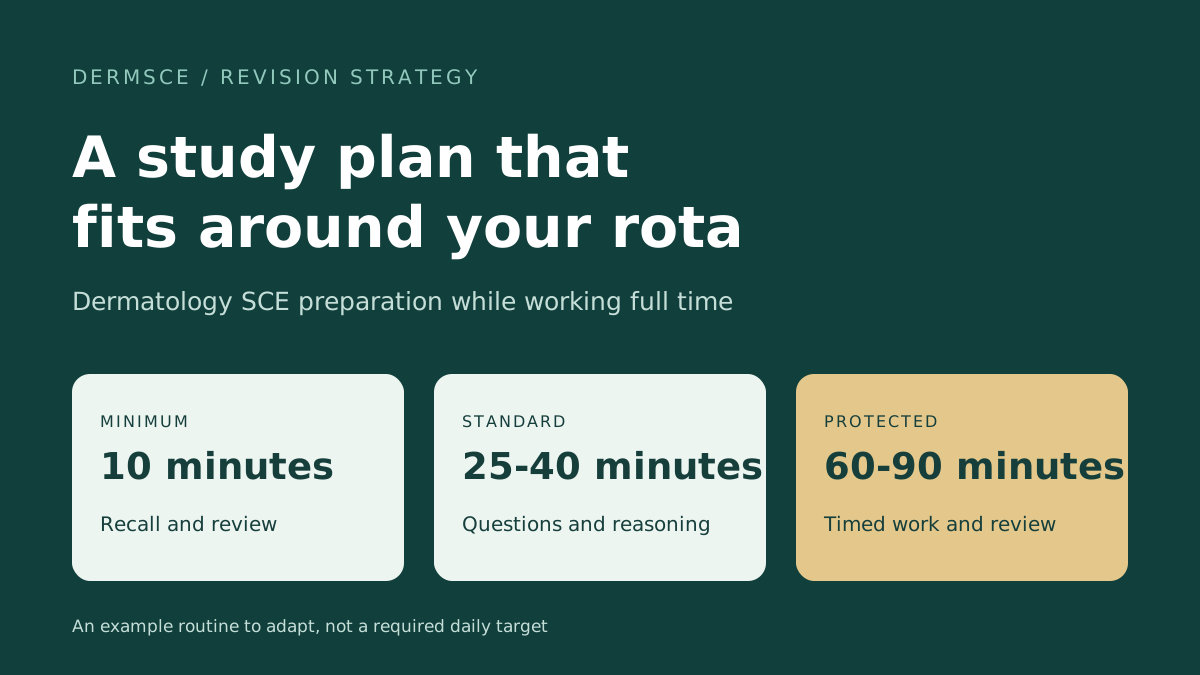
- Minimum session: around 10 minutes. Recall one previous learning point and review a small number of errors. Use this when your day has not gone to plan.
- Standard session: around 25 to 40 minutes. Answer a manageable block of questions and review the explanations. Reduce the question count if the reasoning needs more attention.
- Protected session: around 60 to 90 minutes. Do a longer mixed or timed block, then begin a structured review. Reserve separate time for a full-length paper when your rota allows.
These times are examples, not requirements. A short session with deliberate review can be more useful than a longer session spent clicking through tired. After nights or a difficult shift, sleep and recovery may be the better choice. Your plan should tolerate that without turning the following day into a punishment.
A realistic sample revision week
- Monday: a standard session on one weak topic. Write down the reasoning behind the mistakes that matter.
- Tuesday: a short retrieval review of Monday's learning points, followed by a few questions from another topic if time allows.
- Wednesday: a mixed question session. Notice whether yesterday's learning transfers when the topic is no longer announced.
- Thursday: a minimum session or planned rest. Revisit an older error rather than opening a large new reading task.
- Friday: targeted reading on one recurring gap, followed by explaining the principle without the book.
- Weekend: one protected timed block and its review, plus a brief plan for the next rota week. Keep space for rest and other commitments.
Move the sessions to fit your actual working pattern. If you work the weekend, your protected block might be on a weekday off. If the week becomes overloaded, keep the highest-value review and drop optional volume. Do not simply add every missed session to the next week.
Turn wrong answers into useful revision
An error log does not need to become a second textbook. For each important mistake, record the topic, the reason you chose the wrong option and the distinction you need to retrieve next time. Keep the note short enough that reviewing it is realistic.
- Knowledge gap: you did not know the relevant fact or principle. Read just enough to resolve it, then test yourself later.
- Discrimination error: you knew both possibilities but missed the clue separating them. Write a comparison rather than another full disease summary.
- Question-reading error: you answered the diagnosis when asked for the next investigation, or overlooked a qualifier. Practise stating the task before choosing.
- Timing or uncertainty: you spent too long deciding between two answers. Review your approach to committing and moving on.
Avoid recording only the option letter. Options can move, and memorising a familiar answer does not show that you could handle a different presentation. Our guide to approaching SBA questions explains how to identify what a stem is actually asking.
Use spaced review without building a complicated system
Practice testing and distributed practice are supported by broader learning research. That supports trying to recall information and returning to it over time, rather than relying only on rereading or highlighting. It does not prove a particular DermSCE schedule will improve an individual's examination result.
As a simple starting point, revisit a learning point after a day or two, about a week later and again after a longer gap. Shorten the interval if you cannot retrieve it, and lengthen it when it becomes reliable. The exact intervals are less important than noticing what you have forgotten and responding to it.
Try to answer before looking at your note. You might explain a diagnostic distinction aloud, write the next investigation or describe the feature you would look for in an image. Then check the answer and correct errors promptly.
Balance topic practice with mixed questions
Topic blocks are useful when you are building a framework or repairing a specific gap. Mixed questions remove the clue supplied by the topic heading and ask you to switch between areas. Most candidates will need both types of work rather than choosing one permanently.
As your coverage improves, include more mixed sessions while keeping targeted review for persistent weaknesses. Leave some unfamiliar material for later checks. A high score on repeatedly seen questions should not be interpreted in the same way as performance on fresh items.
Do not leave images and timing until the final week
Include clinical images, dermoscopy and histology in your regular study, using appropriately licensed resources. Describe the visible features before naming a diagnosis. If you cannot explain what you are seeing, a correct label may have come from recognition rather than a reliable method.
Use a larger screen when it helps you inspect detail. A phone is convenient for short sessions, but convenience should not stop you seeing the relevant feature. Our dermatopathology revision guide offers a structured starting point for histology practice.
Timed practice is also a skill to develop gradually. Use shorter timed blocks first, then schedule longer sessions when you can protect the time and review them properly. Check the official examination instructions rather than assuming your revision app reproduces every exam-day detail.
Use your phone for continuity, not constant study
A mobile question bank can make a planned short session easier to start. Prepare downloaded or cached material before a journey and use only safe, appropriate breaks. Avoid starting a demanding session when you are about to return to clinical work.
The DermSCE iPhone app guide explains topic practice, mocks, the revision book and the limits of offline access. Offline study still needs preparation, and progress cannot appear on another device until it has synchronised.
Review the plan once a week
- Which topics have I not sampled yet?
- Which errors keep returning after I thought I understood them?
- Am I reviewing explanations, or only increasing my completed-question count?
- How am I doing on fresh mixed questions rather than repeated items?
- What does next week's rota realistically allow?
Choose one or two priorities for the next week. If every topic is marked urgent, the plan is not helping you decide. In the final phase, use the final four weeks guide to narrow the focus without abandoning breadth.
Frequently asked questions
How many hours should I study each day? There is no universal daily number. Use your starting knowledge, available preparation time and performance on unfamiliar material to adjust the plan. Consistency does not require studying every day.
How many questions should I do? Enough to expose gaps while leaving time to understand the explanations. Ten carefully reviewed questions may be a better session than a much larger block with no review; neither number is a prescribed target.
What should I do after falling behind? Re-plan from today. Keep the most important topic gaps and spaced reviews, reduce optional reading and avoid an unrealistic catch-up schedule.
Can I prepare while working full time? A flexible plan can accommodate full-time work, but individual circumstances differ. Discuss study leave and support early, and do not judge your readiness by another candidate's timetable.
Your next step
Choose a realistic week, protect one longer session and decide what your minimum session looks like. Then start with questions that show you what needs attention. You can try DermSCE on the website, but whichever resources you choose, keep the official blueprint and your own learning gaps at the centre of the plan.
Sources & further reading
- MRCP(UK): Dermatology Specialty Certificate Examination
- Dunlosky and colleagues: Improving Students' Learning With Effective Learning Techniques (2013)
- A Meta-Analysis of Ten Learning Techniques (2021)
For educational use only. Check current official guidance.
Start 25 free questions